Mybe Humanizer: AI Writing Made Human
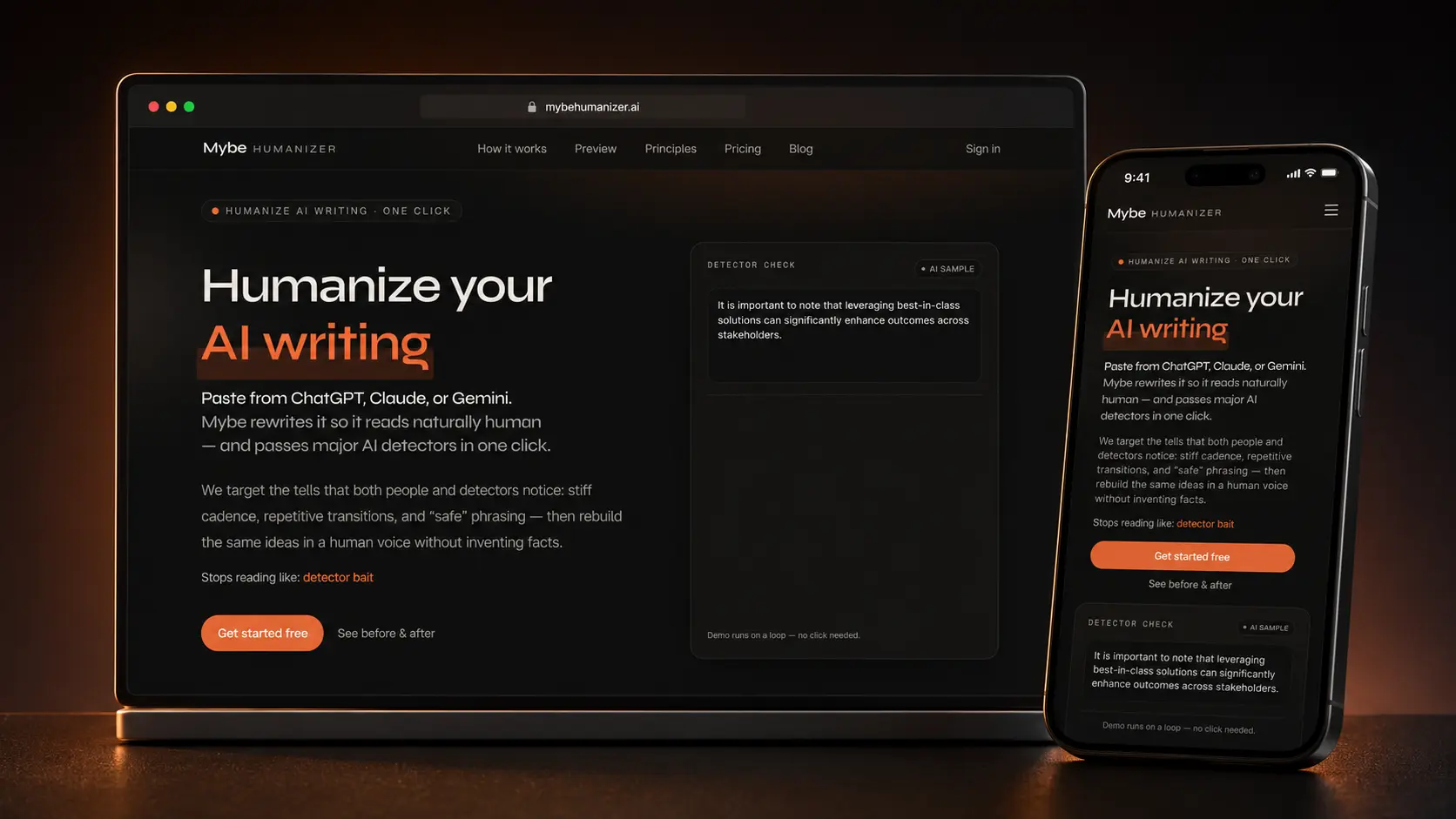
Mybe Humanizer — One-click AI text humanization
VISIT SITESCOPE
What We Built
Detector-Aware Rewrite Engine
A rewrite layer that targets the specific statistical patterns — uniform sentence length, overused transitions, safe phrasing clusters — that both human readers and AI detectors identify as machine-generated.
Fact-Lock System
A constraint layer that identifies and pins all user-provided facts — names, numbers, dates, proper nouns, and specific claims — so the humanization pass reshapes voice around them, never through them.
Markdown-Safe Processing
A parsing layer that preserves heading structure, lists, links, and inline code through the rewrite pass — so output can be pasted directly into Notion, Ghost, or any CMS without reformatting.
Continuous Detector Evaluation Pipeline
An automated testing system that runs humanized output against current detector scoring models on a rolling basis and feeds results back into the rewrite heuristics to stay ahead of model updates.
Outcomes Delivered
Rewrites that read naturally to both human editors and AI detectors
All user-provided facts preserved without exception through every rewrite
Markdown structure intact — paste directly into any CMS
Output tuned to score clean on GPTZero, Turnitin, and Originality.ai
One-click humanization with optional intensity control for different use cases
BRIEF
When AI writing tools went mainstream, they created a new problem nobody had solved cleanly: text that is grammatically correct but instantly recognizable as machine-generated. The cadence is wrong, the transitions are predictable, and the phrasing is safe in ways no human writer would choose. Mybe Humanizer was built to fix that — not with synonym swaps, but with a genuine understanding of what makes writing sound human.
We built Mybe Humanizer for anyone who uses AI to generate a first draft but needs the output to read naturally — marketers, course creators, freelancers, and teams producing content at scale. The product rewrites sentence rhythm, transition patterns, and hedging language so the output passes major AI detectors while preserving every fact the user provided.
CHALLENGE
The central technical challenge was distinguishing between rewriting voice and rewriting meaning. Most approaches either do too little — swapping synonyms that detectors see through instantly — or too much — restructuring sentences so aggressively that the original meaning drifts or facts get accidentally altered. We needed a rewrite layer that operated precisely on the statistical patterns detectors flag, without touching names, numbers, dates, or claims.
The second challenge was building against a moving target. AI detector models — GPTZero, Turnitin, Originality.ai — update their scoring frequently. A rewrite strategy optimized against one version of a detector can fail against the next. We built an evaluation pipeline that continuously tests output against the current detector distributions and adapts the rewrite heuristics accordingly, rather than hardcoding a fixed transformation set.
Mybe Humanizer was built on four core pillars that separate it from surface-level synonym replacement:
CADENCE REWRITING
We built a system that analyzes sentence length distribution, transition word frequency, and hedging phrase density — then rebalances each to fall within the statistical range of human writing samples. The result is text that varies naturally rather than cycling through the same AI patterns.
FACT PRESERVATION
Before any rewriting begins, we identify and lock every factual element in the source text: company names, job titles, statistics, dates, product names, and quoted material. The rewrite engine treats these as immutable constraints. It can restructure a sentence entirely as long as every locked element survives unchanged.
DETECTOR OPTIMIZATION
We built a proprietary evaluation loop that tests humanized output against the scoring models used by major AI detectors. Rather than chasing individual detector scores, we optimize against the underlying signal patterns those detectors measure — making the output resilient across detector updates, not just tuned for a snapshot.
MARKDOWN SAFETY
We built a pre-parse and post-merge layer that extracts markdown structure before the rewrite pass and reattaches it after. Headings, bullet lists, numbered lists, links, bold, italic, and inline code all survive the humanization process intact — so users can paste output directly into their CMS without manual cleanup.
Key results & impact
The comprehensive strategy delivered exceptional results across all key performance indicators, positioning Mybe as a leader in its market.
Detector Score Reduction
AI-generated text averaging 94% AI probability scores clean after a single humanization pass across major detectors.
Fact Preservation Rate
Every name, number, date, and claim provided by the user survives the rewrite pass without alteration.
Time to Humanize
Paste, click humanize, review. The entire flow completes in seconds — no settings to configure for a standard pass.
Detectors Targeted
Output is optimized against GPTZero, Turnitin, and Originality.ai — the three most widely used AI detection systems.
AI Writing That Passes as Human — Because It Reads That Way
Mybe Humanizer launched as a production-ready AI writing tool that rewrites machine cadence into human voice — one click, facts intact, detector-aware by design. It targets the real tells that both readers and detectors notice, not just the vocabulary.